
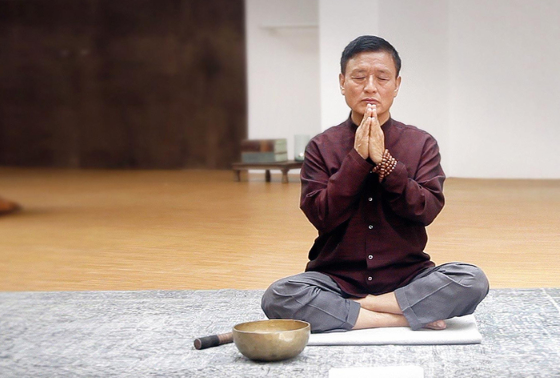
During this next portion of the retreat we will be remaining in silence. Among the aspects of stillness, silence, and spaciousness, it is particularly important that you recognize your own experience with the stillness and with the silence.
It’s very difficult, isn’t it, for people to not do anything? Particularly in the Western world, where the focus is more on action, and on the doing. We identify with what we do, don’t we? And we identify with what we have. But we don’t identify so much with how we are.
If asked, who are you, the typical response would be something like, oh I’m a lawyer. And if asked why they said that, typically they’d answer, because I practice law. So who I am, my identity, is what I do. But the truth is, that this is not the case – you are not what you do. And definitely, you are not what you have. That is another form of mistaken identity for many in the West, where your worthiness is defined by the amount of wealth or material possessions that you have. We know that those notions are incorrect.
So in meditation, when you’re trying to be still, or when you’re challenged to be still, just observe, what is your experience of that stillness? Or if you are sitting in silence, then what is it like for you? It may be that the silence is boring, or it might be that the silence is like music. Right? See for yourself; is the silence a peacefulness, or is it various disturbances? What does the quality of silence look like to you?
The idea of our resting in stillness and silence, and in some sense, doing nothing, it’s not an easy thing to do. It is a means, though, for our sensing something deeper, a sense of completeness, in that action-less stillness. Many times when we are trying to do something, it’s as if we are avoiding seeing something inside ourselves. But here in this meditation we are challenged to not do anything. And in this non-doing, we don’t identify with anything, and through that we can find a deeper identity beyond what we do.
And I think silence in particular here is the key element, because the non-action of stillness alone is not in itself a meditation. However, our non-action accompanied by the silence of simple awareness, is a meditation. Earlier in the retreat, I overheard someone saying, I won’t be attending the second week of the retreat, because I like to talk. [laughter] Sure, if you love to talk, then vowing to keep oneself in silence for 5 or 6 hours each day is hard, right? Let me see how many of you enjoy silence? [a number of people raise their hand] Okay, and how many of you love to talk? [most attending raise their hand] Silence is interesting, isn’t it? We all know how talking, communicating and engaging feels lively. Whereas, our not talking, our not engaging feels a little bit unfamiliar. But then as you go deeper into the silence, it feels beautiful. It feels very peaceful. But there are stages that you go through in the process, and that process does not always feel very familiar. Nevertheless, there is clearly a path toward that inner peace, and it starts with our minimizing our talking.
This principal aspect that the word silence points to is not simply being quiet. Because, there are likely a lot of people who just don’t talk and remain silent throughout their lifetime. They probably should talk, though. There are actually things that they are supposed to talk about, and yet they just won’t talk. Their silence is not fun. Silence for them is not a joy. Rather, you can see so much pain and depression in their silence.
So you don’t want to rest in that kind of silence. Rather you want to feel the silence as a music, as a joy. Clearly silence is very peaceful. But you have to taste the peace in the silence, otherwise silence itself can be boring. You have to taste some sense of light in this silence, otherwise silence can be dark. In short, there are qualities that are experienced in this silence. And three main qualities experienced in this silence are joy, love and a sense of, all is good, or in Tibetan, Kuntuzangpo. So when you’re listening to the silence, you are being nourished with all of the qualities that are in that silence. Like being nourished by hearing music that you love. Although, here it’s not that you are listening to something happening out there. It is something that you experience as some aspect of yourself. Everything’s happening in here. And I think it’s good to feel joy, love, light, liveliness, music, melody, peace in that silence. And the outer circumstances or the outer situation is simply a trigger for that.
In short, then, enjoy the silence and try to taste different qualities in the silence and in particular, try to taste a quality that you miss in your life. It may be the sense of, all is good, or Kuntuzangpo. So simply rest in the silence [Rinpoche rests]. And then internally you may say, all is good… all is good… Kuntuzangpo… Kuntuzangpo… Kuntuzangpo. Though you may not feel like all is good, still you can say it. All is good. If you repeat those words again and again, then the brain can rewire itself to return to those very patterns that it’s been practicing most. All is good. And then over time you will not need to say, all is good, to actually feel like all is good. And then, you simply be in that all-goodness; you simply be in that Kuntuzangpo.
That’s a great way of being in silence, while resting in the stillness. And we will practice that over the next few days here at the retreat. However, if sometime you happen not to be feeling that way, feeling all is good, then that’s completely okay, too. Don’t try to push yourself into feeling good. Rather recognize at that point that it’s better to be open and simply ask yourself, as you would a friend, how are you feeling? What are you feeling? And allow the expression of it for that to clear.
Earlier a student mentioned that she went from experiencing a feeling of oneness with everything, to later her experiencing a really deep sadness and sense of disconnection. Sometimes with these experiences of, say, sadness or disconnection, or anger, it’s more a matter of allowing those experiences. So, first of all, as a dzogchen principle, we say that any and all of these emotions are not bad. That’s the first thing to realize. Sure, it may not necessarily be a pleasant experience that you’re having, but it’s not bad as such. So being open, look at it positively. Then you can say and feel, okay now I will simply allow it, and feel it. Because, everywhere that you’re feeling it in your body, there’s a release of something. As well, if you’re experiencing something conceptually or emotionally, and you are attempting to understand it psychologically and you reflect deeper, then something is getting clear there, too. So, there’s always something good about having those kinds of experiences and not rejecting them.
So basically, just allow. And in the dzogchen teachings, it says that these emotions are simply energy. And therefore our seeing these emotions as if they are an error, is actually mistaken. The teachings go on to say that the approach or the meditation for any one of them is, leave it as it is. And then the fruition of this view and meditation on them is the dissolution or the cessation of them in the base. That means that when a negative thought or emotion arises, you simply leave it as it is and you just observe it, then it dissolves.
None of that problem or that pain will last unless you contribute more to it. But if you just let it breathe, then naturally it releases. But if you try to stop it, then it will stay longer. So again, not rejecting it is the first step. I know that can be a little bit hard at times. Who wants to feel sad, right? But at least you have in the back of your mind the trust that it’s okay to feel that way. And then you can come to know that feeling sad is okay. And you come to know that even the tears are good. And you come to allow the expression of your sadness, or the expression of your joy to manifest in the drops of the tears from your eye. The eyes are involved, the tears are involved, sounds are involved, maybe even the shaking of your body is involved. It’s important to allow all of that. Right? So it’s good to feel things.
Okay, so let’s open to our experience of silence over these next few days of the retreat.